Standing on the east bank of the Nile, 📍Luxor Temple is one of the most impressive ancient temples in Egypt. Built during the New Kingdom period, it offers a unique opportunity to experience the many layers to Egypt’s long history. Alongside its original Egyptian architecture and artwork, you’ll find reliefs of Alexander the Great, colourful Roman murals, Christian symbols and even a mosque built quite literally on top of the ruins.
Located in downtown Luxor, this temple is one of the country’s most popular historical attractions, and definitely belongs on your Egypt itinerary.
In this guide, you’ll find everything you need to know about visiting Luxor Temple, including its history, what to see, how to get there, ticket info and more…
Best Luxor Temple Tours
I’ve done the research so you don’t have to. Here are the top Luxor Temple tours depending on what you’re looking for…
⭐ Luxor Temple + Karnak Temple
⭐ Luxor Temple + Karnak Temple, Valley of the Kings, & Hatsheput Temple
Contents
History of Luxor Temple

Luxor Temple was built during the height of Egypt’s New Kingdom, often considered the golden age of ancient Egyptian civilization. During this period, the capital had shifted from Memphis to Thebes (modern-day Luxor).
Construction of the temple began around 1400 BCE under Pharaoh Amenhotep III, who built much of the temple’s inner sanctuary, courtyards and famous colonnade. Around a century later, Ramesses II expanded the complex by adding the monumental entrance pylon, colossal statues of himself and two giant obelisks, one of which still stands today (the other is in Paris). While later pharaohs also made additions, most of the temple seen today dates to the reigns of these 2 pharaohs.

Luxor Temple was connected to nearby 📍Karnak Temple by the Avenue of Sphinxes, a 2.7km processional road lined with hundreds of sphinx and ram-headed statues. Together, the two temples played an important role in the annual Opet Festival, during which statues of the gods were carried in procession between the 2 temples.
Following Egypt’s conquest by Rome, the temple was converted into a Roman military fortress, with colourful Roman wall paintings added to parts of the complex, which you can still see today.

After the rise of Christianity, the traditional ancient Egyptian religion faded into history while the temple was converted into a church. By the 13th century CE, the temple had been abandoned and the sands of the Sahara had buried all but the tallest parts of the structure.
The town of Luxor was built over the top of the ruins, where the Abu Haggag Mosque was constructed at what was then ground level.
By the 19th century, the temple caught the attention of Western archaeologists, who began excavating the site. The mosque was kept in place, with the ground being dug out from beneath it, unveiling one of the best preserved ancient Egyptian temples.
Today, Luxor Temple is one of Egypt’s most popular historical sites.
Things to See at Luxor Temple
Pylons

The first thing you’ll see as you approach Luxor Temple is its monumental pylon. A common feature of ancient Egyptian temples, a pylon consists of two massive towers that form the main entrance.
The pylon at Luxor Temple was built by Pharaoh Ramesses II (1279–1213 BCE), who also commissioned the colossal statues of himself that guard either side. As you explore the temple (and the rest of Egypt), you’ll notice that Ramesses had no shortage of statues built in his own honour.
The face of the pylon is decorated with reliefs depicting Ramesses II’s victory at the Battle of Kadesh against the Hittites, a scene he famously had carved onto many of his monuments throughout Egypt.
Originally, two towering obelisks stood in front of the entrance. Today, only one remains. The other was gifted to France in 1833 and now stands in the Place de la Concorde in Paris.
Court of Ramesses II
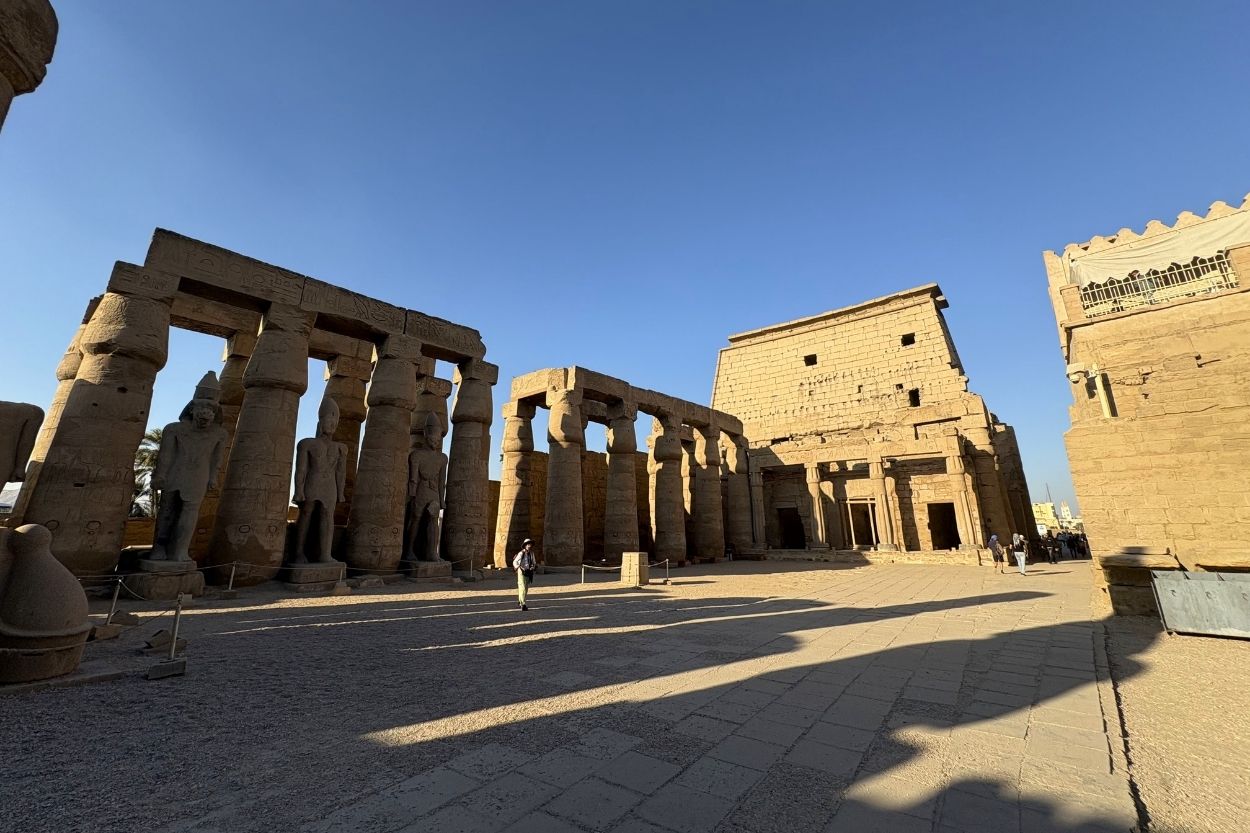
After passing through the pylon entrance, you’ll arrive at the Great Court of Ramesses II, another addition made to Luxor Temple by the famous New Kingdom pharaoh.
The large open courtyard is surrounded by rows of towering columns and seated statues of the man himself. Along the surrounding walls, you can still see reliefs showing Ramesses making offerings to the gods and performing important religious ceremonies.
Look up, and you’ll find a mosque built atop part of the structure, with its doorway seemingly dropping into the courtyard (more on that next).
Beyond the court, the temple continues through a long colonnade that leads towards the older sections of the complex built under Amenhotep III.
Abu Haggag Mosque

Within the Court of Ramesses, if you look up, it’s impossible not to notice a mosque built on top of part of the temple.
Originally a Byzantine Christian church (later converted into a mosque), the structure was built during a time when the complex was largely covered in sand and the town of Luxor was built over it. At the time, the church was built at ground level.
Later in the 19th century, the temple was dug out from beneath it, but the mosque remained, now leaving it in its strange position atop the temple ruins. The entrance to the mosque is now on the outside of Luxor Temple, but from within the Court of Ramesses, you can still see a door that drops directly into the courtyard.
Thanks to this mosque, Luxor Temple has the claim of being a continuous place of worship for thousands of years.
Sun Court of Amenhotep III

Continuing beyond the Court of Ramesses II, you’ll reach the slightly older sections of Luxor Temple, built during the reign of Pharaoh Amenhotep III.
The first area you pass through is the Colonnade of Amenhotep III, a grand walkway lined with towering columns reaching around 16m high. Beyond this lies the Sun Court of Amenhotep III, the largest open area within the complex.
The courtyard is surrounded by rows of massive columns and was an important ceremonial space used for religious rituals and festivals, including the annual Opet Festival.
Hypostyle Hall & Inner Sanctuary

Pass through Amenhotep’s Sun Court and you’ll reach the more sacred and restricted areas of the temple: the Hypostyle Hall and Inner Sanctuary.
Like many ancient Egyptian temples, Luxor Temple was designed so one would move from the open and public areas, through the hypostyle hall and into the enclosed and sacred area where only priests and the Pharaoh himself were permitted.
Luxor Temple’s hypostyle hall may be missing its roof, but it’s no less impressive, with its 32 towering stone columns still standing.
Continue through the hall and you’ll reach the Inner Sanctuary, the holiest place in the temple, dedicated to the deity Amun. This inner sanctuary was rebuilt during the brief reign of Alexander the Great in the 4th century BCE, and inside it you can still make out reliefs depicting him as pharaoh.
Roman Frescoes

They say history is built in layers, and there is a perfect example of that in Luxor Temple in the form of colourful Roman murals.
After Egypt became part of the Roman Empire in 30 BCE, the temple was adapted for military use. During this period, parts of the temple were transformed into a Roman shrine, and colourful frescoes were painted over some of the earlier Egyptian artwork.
Located near the rear of the temple, beyond the Inner Sanctuary, these paintings depict Roman emperors in the distinctive art style of the Roman period, standing out in contrast to the traditional Egyptian art.
Avenue of Sphinxes

Before leaving Luxor Temple, be sure to check out the Avenue of Sphinxes, the ancient processional road that once connected Luxor Temple with the nearby Karnak Temple.
Stretching approximately 2.7km, this avenue is lined with hundreds of sphinx and ram-headed statues. While it may have existed for some time, the statues are believed to have been added in the 4th century BCE.
It was along this road that statues of the gods would be carried between the 2 temples during the annual Opet Festival.
Today, the Avenue of Sphinxes is particularly impressive after sunset, when the statues are lit up.

Is Luxor Temple worth visiting?
If your time in Luxor is limited, you might be wondering if Luxor Temple is worth including in your itinerary. The short answer is yes, but it depends on how much time you have and what other sites you plan to visit.
From a historical perspective, Luxor Temple is one of the most significant temples from Egypt’s New Kingdom, a period often considered the height of ancient Egyptian civilization.
Many of its monuments, including its pylons, its many Ramesses II statues, its great hypostyle hall and towering stone columns, are all impressive but not unique to Luxor Temple. These are features you will see in other ancient Egyptian temples, like nearby Karnak Temple.
What is unique about Luxor Temple are things like its reliefs of Alexander the Great, its colourful Roman frescoes, and having a mosque built quite literally on top of the ruins. All things that exemplify ‘history in layers’.
So, the temple is historically significant and has interesting things to see, but how does it compare to the many other historical sites in town? In my opinion, it ranks behind the Valley of the Kings and nearby Karnak Temple.
If you only have time to visit either Karnak Temple or Luxor Temple, choose Karnak.
That being said, both temples are located near each other and it’s very quick and easy to visit both in the same morning/afternoon.

Where is Luxor Temple?
📍Luxor Temple is located in the heart of modern-day 📍Luxor, on the east bank of the Nile River in southern Egypt.
If you’re staying in Luxor, it’s recommended you stay on the east bank downtown area, where most hotels and restaurants are located. From here, Luxor Temple is easy to reach, and likely within walking distance from your hotel.

How to get to Luxor Temple
Option 1: By Taxi
Depending on where you’re staying in Luxor, the temple may be too far to walk to. In this case, the simplest transportation method is a taxi.
Taxis are widely available across the city and take about 10 – 15min from central Luxor to the temple entrance.
The exact price will depend on where you’re coming from and your haggling skills, but expect to pay about 50 to 100 EGP each way.
Option 2: By Guided Tour
If you want transport and all the other logistics handled for you, I recommend booking a guided tour to Luxor Temple.
Luxor has many local tour operators offering trips to the temple, as it is one of the city’s most visited attractions. Many tours combine Luxor Temple with nearby Karnak Temple (like this one), while others offer full day tours that also include top historical sites on the West Bank (like the Valley of the Kings and Hatshepsut Temple).
Option 3: By Nile Cruise
Another popular way to visit Luxor Temple is as part of a Nile cruise.
These cruises are one of the most popular things to do in Egypt and a great way to tick off a bunch of the country’s top historical sites in a short amount of time. Cruises typically run between Luxor and Aswan, and include all the top sites in and between the cities (including Luxor Temple).
A cruise usually covers transport, accommodation, entry tickets and provides you with an Egyptologist guide to show you around. In between tours, you’ll get to sit back and relax on the boat, which typically features a rooftop pool, lounge, bar and buffet.
Cruises vary in length, typically ranging from 3 to 10 nights. You can browse available Nile cruise options and pricing on Get Your Guide or Viator.
Best Luxor Temple Tours
I’ve done the research so you don’t have to. Here are the top Luxor Temple tours depending on what you’re looking for…
⭐ Luxor Temple + Karnak Temple
⭐ Luxor Temple + Karnak Temple, Valley of the Kings, & Hatsheput Temple


Luxor Temple Opening Hours
Luxor Temple is open from 6am to 7pm all year round, including during Ramadan.
The most popular (and crowded) time to visit Luxor Temple is just before sunset, which gives you ample time to explore the ruins in the daylight, and see them lit up after dark.
Luxor Temple Ticket Info
The ticket prices for Luxor Temple are:
- EGP 500 – Adults
- EGP 250 – Students
Tickets can be purchased from the ticket booth at the entrance, or online in advance from the official ticket website.

How long does it take to visit Luxor Temple?
While it’s a large complex, Luxor Temple is smaller than nearby Karnak Temple and much quicker to visit.
I recommend planning 1 to 2 hours to visit Luxor Temple. This gives you ample time to explore all areas of the complex without rushing. If you’re the kind of visitor who likes to take their time and appreciate everything the site has to offer, plan at least 2 hours. If you’re in a rush, it’s easily possible to explore Luxor Temple within 1 hour.

More historical sites in Luxor
As the site of the New Kingdom capital of Thebes, Luxor is one of the top destinations in Egypt. Here are some other top sites you may want to include in your itinerary:
For more travel guides to Egypt’s historical sites, check out our Egypt home page.